
About The Project
The Problem Ecopesia Aims to Address
European agriculture faces several urgent ecological and land-management pressures including:
Habitat and soil degradation
Currently, 81% of protected habitats across Europe are in a poor or bad conservation status (EEA), and 60% to 70% of European soils are degraded due to human activities, intensive management, pollution, and erosion (Directorate-General for Environment).
Decline of pollinators
One in three pollinator species is in decline, jeopardising the 84% of European food crops that rely directly on insect pollination (EC).
Wildfires and land abandonment
The decline and abandonment of extensive livestock grazing have led to dense accumulations of dry shrubs and grass that fuel fires. More than 500,000 hectares burn across Europe each year, surpassing roughly 1 million hectares in 2025 alone (JRC).
Low uptake of sustainable practices
Regenerative, nature-based farming systems remain underutilised across Europe’s Utilised Agricultural Area (UAA), covering only 10.9% for organic farming, 9% for agroforestry, and 19.8% for extensive grazing. (FiBL, European Parliament, EC)
Remuneration and policy limits
Existing remuneration frameworks, such as CAP eco-schemes, struggle with complex paperwork, and rely on standard practice-based rules rather than measurable outcomes. There is insufficient funding, and limited engagement with private buyers.
What is a PES Scheme and the project ambition beyond the State-of-the-Art
Financial incentives to adopt agricultural practices that improve soil quality, increase biodiversity, and prevent wildfires (such as the CAP eco-schemes) are insufficient.
A Payment for Environmental Services (PES) scheme provides economic incentives to land managers and farmers for voluntary actions that generate and protect public goods (such as clean water, healthy soils, and biodiversity). To overcome existing barriers and ensure long-term scalability, Ecopesia introduces three core innovations:

©BEEODIVERSITY
Private funding mobilisation
Ecopesia will engage private investment in our 8 case studies by 1) Ensuring return on investment 2) Simplifying administrative processes 3) Aligning PES with EU regulatory drivers that create clear demand for corporate action on natural capital.
Result-based PES via on-farm indicators
To guarantee fair and transparent payments, remuneration must be directly linked to measurable environmental outcomes. Harmonised indicators, such as pollinator density, soil organic matter, and water quality, will help assess environmental outcomes and determine payment for farmers.
Digitalisation of the administrative process
Deploying a dedicated app to simplify farmer enrolment, streamline contract handling, and support transparent payment calculations.
The 5 Agroecosystems
The project works across five diverse European farming systems:
Extensive Grazing
Grasslands
Agroforestry
Dairy Farms
Organic Farming
Indicators
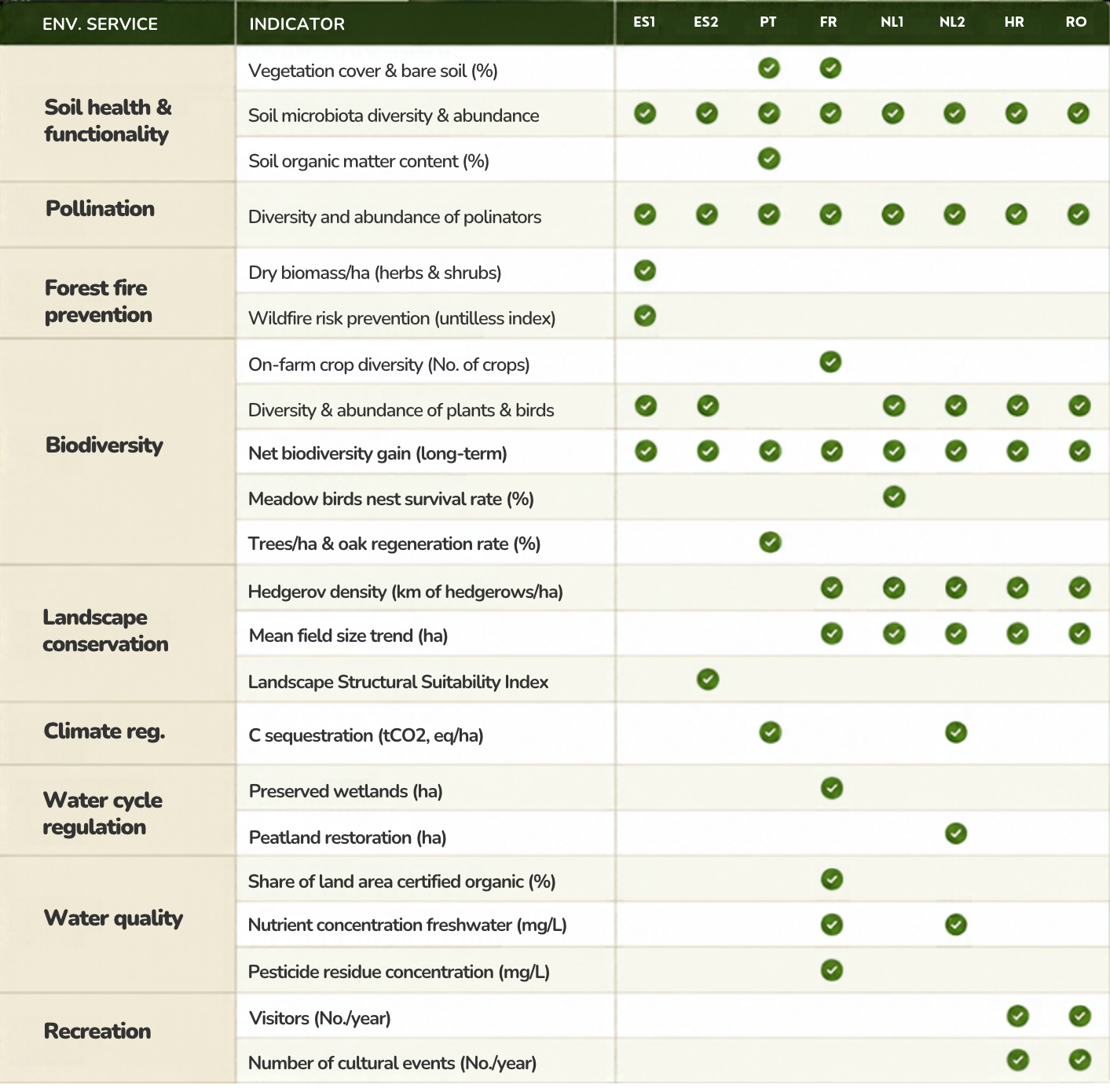
ECOPESIA indicators frameworks are designed to track measurable progress towards the EU Nature Restoration Law targets, particularly aligned with the following Articles: 1) Restoration of the natural connectivity of rivers and natural functions of the related floodplains (Art. 9); 2) Restoration of pollinator populations decline (Art. 10); 3) Restoration of agricultural ecosystems (Article 11, Annex IV).

©BEEODIVERSITY
About The Partners


CITA
Centro de Investigación y Tecnología Agroalimentaria de Aragón
Centro de Investigación y Tecnología Agroalimentaria de Aragón (CITA) is a public research institute based in Zaragoza, Spain, dedicated to agricultural research, technology transfer, and innovation.
Within the Ecopesia project, CITA serves as the overall project coordinator, managing consortium governance, administrative oversight, and open science practices. CITA leads the deployment and scaling of innovative PES schemes and oversees the development of payment calculation methodologies, as well as the implementation of Spanish pilot schemes focusing on extensive grazing, fire prevention, and nature restoration.

INRAE
Institut National de Recherche pour l’Agriculture, l’Alimentation et l’Environnement
INRAE (National Research Institute for Agriculture, Food and the Environment) is France’s leading public research institution dedicated to the sustainable development of agriculture, food, and the environment. In the Ecopesia project, INRAE takes responsibility for evaluating environmental performance metrics and establishing the criteria for result-based payments across pilot sites.
INRAE also plays a crucial role in French pilot scheme deployment, local governance co-design, and policy framework assessments.

ITAB
Institut Technique de l’Agriculture Biologique
ITAB (Institut Technique de l’Agriculture et de l’Alimentation Biologiques) is the French technical institute dedicated to research, development, and knowledge transfer in organic agriculture. Under Ecopesia, ITAB leads the project’s environmental assessment framework and oversees the short term and long-term environmental impact assessments across all pilot regions.
ITAB ensures that monitoring methodologies accurately capture different types of environmental service improvements such as biodiversity gains, soil functionality amelioration, water cycle regulation, and water quality, higher landscape conservation, climate regulation, better pollination, reinforced forest fire prevention, … to validate PES schemes.

WU
Wageningen University
Wageningen University (WU) is a world-renowned Dutch university specializing in life sciences, agricultural research, and environmental studies. In Ecopesia, WU leads the co-design of business models, attracting private capital, and creating policy roadmaps for scaling up PES schemes across Europe. WU also co-manages the Dutch pilot schemes targeting dairy farming biodiversity and peat meadow landscape restoration.

UEVORA
Universidade de Évora
Universidade de Évora (UEVORA) is a leading public university in southern Portugal with extensive expertise in Mediterranean agriculture, forestry, and ecosystem management. Within Ecopesia, UEVORA leads the Portuguese pilot , combining public and private funding to reward measurable environmental outcomes in agroforestry systems. UEVORA also coordinates stakeholder engagement, the co-design of governance arrangements, and local showcase events in Portugal.

FAZ
Sveučilište u Zagrebu Agronomski Fakultet
The Faculty of Agriculture, University of Zagreb (FAZ) is Croatia’s leading higher education and research institution in agronomy and agricultural sciences. Within Ecopesia, FAZ is establishing and coordinating the project’s peer-to-peer showcasing visits across European pilot sites. FAZ also provides key scientific support to the Croatian social farming pilot and contributes to environmental indicator testing and stakeholder training.

BEEODIV
BeeOdiversity
BeeOdiversity is a Belgium-based environmental impact company specialising in biodiversity monitoring and ecosystem restoration tools. In the Ecopesia project, BeeOdiversity is overseeing the monitoring and technical impact assessment of environmental services across all project pilots. BeeOdiversity deploys specialised monitoring systems (such as BeeOmonitoring and BeeOtel) to gather verifiable field data on biodiversity and soil health to anchor result-based payments

AGROAPPS
Agricultural Applications IKE
AgroApps PC is a Greek technology SME specialising in ICT solutions, data analytics, and digital tools for agriculture and environmental management. Under Ecopesia, AgroApps is responsible for architectural design, development, and deployment of the Ecopesia Digital Management Suite. AgroApps integrates multi-source monitoring data, automates contract workflows, and creates customised user interfaces for farmers, private investors, and administrative verifiers.

SOLAGRO
Solagro
Since 1981, Solagro has been applying its expertise to support the energy, climate, agroecological, and food transitions. Its multidisciplinary team of engineers, energy experts, agronomists, social scientists, data specialists, and others takes a systemic approach to the challenges facing living organisms and the environment, with a comprehensive and long-term perspective.
In Ecopesia, Solagro leads the French pilot implementation, managing the expansion of blended finance PES schemes that incentivize water resource protection and biodiversity practices. Solagro also coordinates French stakeholder participation in legal and governance framework developments.

FGN
Fundación Global Nature
Fundación Global Nature (FGN) is a Spanish environmental foundation working to conserve nature and promote sustainable agricultural practices. Under Ecopesia, FGN leads is taking charge of multi-level governance co-design, legal regulatory reviews, administrative contract drafting, and farmer engagement strategies. FGN also leads private funding mobilisation and co-manages the Nature Restoration Fund pilot in Spain.

IFOAM EU
International Federation of Organic Agriculture Movements EU Regional Group
IFOAM Organics Europe represents the European organic movement, advocating for sustainable food and farming systems across Europe. In Ecopesia, IFOAM Organics Europe leads policy recommendation tasks, stakeholder governance dialogues, and European-level networking. It synthesises project learnings into actionable policy briefs for EU decision-makers and organises major policy engagement events in Brussels.

ERDN
European Rural Development Network
European Rural Development Network (ERDN) is an international network headquartered in Poland that brings together research institutes working on rural development, agricultural economics, and policy. Under Ecopesia, ERDN leads the Knowledge transfer and capability building. ERDN conducts comprehensive financial viability and social impact assessments (S-LCA) of PES models and builds the open-access European PES Knowledge Repository Hub.

GAL
Asociatia Grupul de Actiune Locala Napoca Porolissum
Asociatia Grupul de Actiune Locala Napoca Porolissum (GAL) is a Romanian Local Action Group working under the LEADER approach to foster rural development, community heritage, and sustainable agriculture in Cluj County. In Ecopesia, GAL leads the Capacity building for farmers and manages the Romanian pilot scheme, introducing mixed crowdfunding models to preserve species-rich meadows and cultural landscapes.

F6S
F6S EU Tech Innovation Network DAC (Ireland) & Affiliated Entity F6S UK
F6S EU Tech Innovation Network DAC is a global platform connecting startup ecosystems, SMEs, and innovation programs. In Ecopesia, F6S leads WP3 (Open Call management providing cascade funding to tech SMEs) and WP8 (Communication, dissemination, and public engagement). F6S also manages the Exploitation and Intellectual Property (IPR) Board. F6S UK acts as an affiliated entity providing compliance, KYC, and financial checks for sub-grantee contracts.

FC
FC.CV
FC.CV is a Dutch consultancy and network organisation focused on sustainable agricultural supply chains, land management, and multi-stakeholder initiatives. Within the Ecopesia project, FC co-leads the execution of the Dutch “Biodiversity Boosters” pilot scheme, facilitating private sector B2B investments into biodiversity-friendly dairy farming practices.

DGS
Zuivelcoöperatie DeltaMilk B.A.
Zuivelcoöperatie DeltaMilk B.A. is a Dutch dairy farmer cooperative committed to sustainable milk production and regional landscape stewardship. Under Ecopesia, DeltaMilk co-manages the Dutch Landscape Fund pilot scheme, engaging member dairy farmers in collective result-based PES schemes aimed at peat meadow restoration and sustainable land management.

CSP
Cork Supply Portugal SA
Cork Supply Portugal SA is an international producer and supplier of high-quality cork closures, deeply rooted in sustainable forestry value chains. In Ecopesia, Cork Supply Portugal acts as a key private co-investor in the Portuguese agroforestry pilot, funding result-based incentives for farmers implementing oak regeneration and soil conservation practices.

HPK
Hrvatska Poljoprivredna Komora
The Croatian Chamber of Agriculture (Hrvatska Poljoprivredna Komora – HPK) is the official national organisation representing Croatian farmers and agricultural producers. Under Ecopesia, HPK leads the Croatian pilot scheme, establishing community-supported, result-based PES mechanisms and crowdfunding platforms. HPK also coordinates Croatian farmer engagement, training sessions, and policy recommendation activities.

REDEIA
Red Eléctrica de España S.A.U.
Redeia (Red Eléctrica de España S.A.U.) is the manager and operator of the Spanish national electricity grid. Participating in Ecopesia as an Associated Partner, Redeia funds and supports the Spanish B2B pilot scheme, using extensive livestock grazing under power transmission corridors to prevent wildfires, support pastoral farming, and enhance biodiversity.

GPP
Gabinete de Planeamento, Políticas e Administração Geral
GPP (Gabinete de Planeamento, Políticas e Administração Geral) is the planning and policy body of the Portuguese Ministry of Agriculture and Fisheries, responsible for policy design, CAP strategic planning, and administrative monitoring. In Ecopesia, GPP participates as an Associated Partner, providing policy alignment and governance advice to integrate result-based PES schemes with public CAP frameworks.